Trading Strategies to Test on a Demo Account
A Demo Account is an ideal environment for testing trading strategies before committing real capital. Each strategy should be evaluated over a minimum of 50–100 trades before drawing any conclusions about its effectiveness. Below are five strategies of varying complexity that can be tested with virtual funds at using virtual funds only. Each strategy includes recommendations for indicator settings, suitable expiration times, and the type of market conditions it performs best in.
1. RSI Strategy (Relative Strength Index)
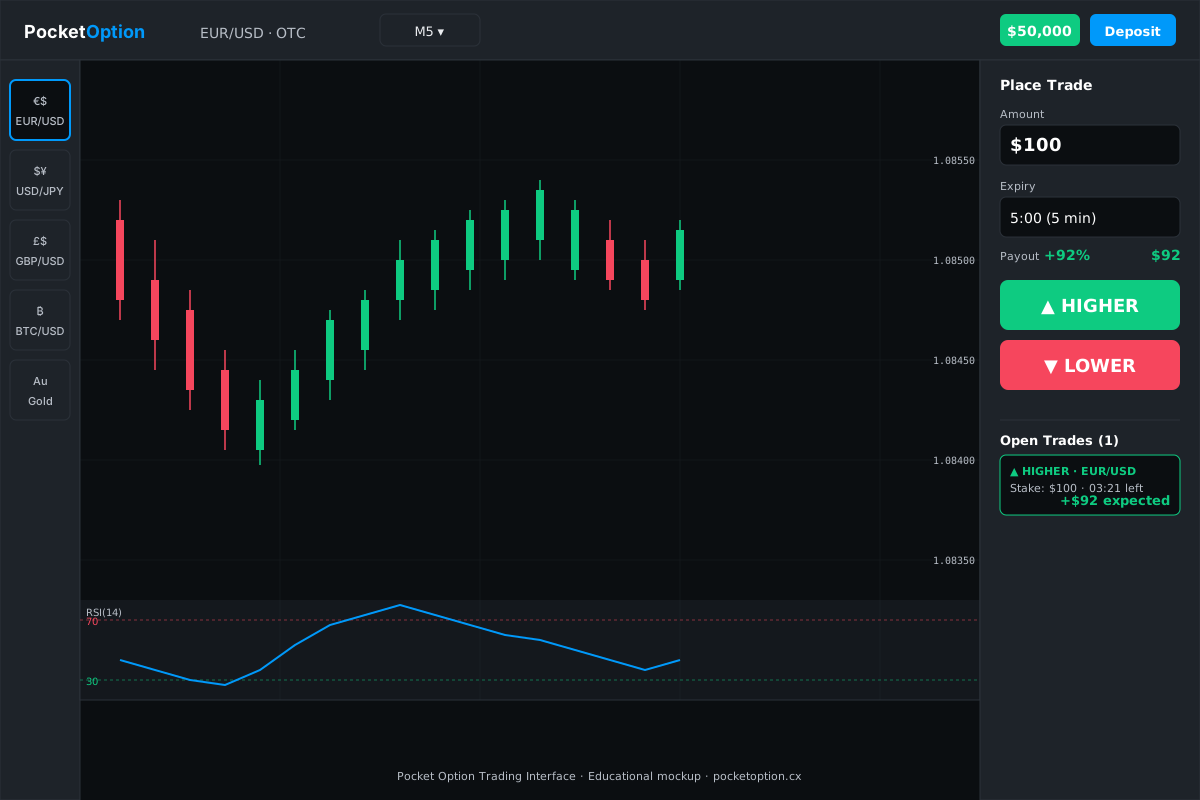
RSI is an oscillator that measures the speed and magnitude of price movements. Its value ranges from 0 to 100. The overbought zone (above 70) signals a potential downward price reversal, while the oversold zone (below 30) signals a potential reversal to the upside. The strategy is straightforward and well-suited for beginner traders: wait for RSI to enter one of the extreme zones, confirm the signal with a reversal candlestick pattern (hammer, engulfing, doji), and open a trade in the direction of the anticipated reversal. Recommended expiration: 3–5 minutes for the 1-minute timeframe (M1), 15–30 minutes for the 5-minute timeframe (M5). The standard RSI period is 14, but for short-term trading it can be reduced to 7–9.
2. Bollinger Bands Strategy
Bollinger Bands consist of three lines: a moving average (SMA with a period of 20) and two bands placed two standard deviations above and below it. Statistically, price touching the upper band tends to reverse downward, while price near the lower band tends to reverse upward. On a demo account, test this strategy on assets exhibiting sideways movement (flat), where bounces off the bands are most predictable and frequent. Avoid trending markets — during a strong, sustained trend, price tends to "hug" one of the bands and repeatedly break through it, making the strategy unprofitable. Recommended expiration: 5–15 minutes. Additional filter: a band squeeze indicates an upcoming strong impulse move — it is best to avoid trading during this phase.
3. Moving Average Crossover Strategy
Use two exponential moving averages with different periods — a fast one (EMA 9) and a slow one (EMA 21). When the fast EMA crosses the slow EMA from below — it is a buy signal (Call), indicating the start of an uptrend. When the crossover occurs from above — it is a sell signal (Put), indicating the start of a downtrend. The strategy works best in trending markets and on larger timeframes (M5, M15), where false crossovers are significantly less frequent than on 1-minute charts. On a demo account, execute a minimum of 50 trades using this strategy to objectively assess the win rate. Recommended expiration: 15–30 minutes for the M5 timeframe, 30–60 minutes for M15.
4. Candlestick Pattern Strategy (Price Action)
Candlestick patterns (Price Action) are one of the oldest and most reliable methods of market analysis, requiring no additional indicators. On a demo account, practice identifying key reversal patterns: the hammer and hanging man form at potential trend reversal points; bullish and bearish engulfing patterns signal a sharp shift in market sentiment; the doji indicates indecision and equilibrium between buyers and sellers. Each pattern has a strict context for application — the hammer is only effective after a downward move, and an engulfing pattern requires confirmation on the following candle. Recommended expiration: equal to the duration of one to two candles on the chosen timeframe.
5. Combined Strategy (RSI + Bollinger Bands)
Combining two indicators significantly reduces the number of false signals and improves overall entry accuracy. The condition for opening a Call trade: the price touches the lower Bollinger Band while the RSI is simultaneously in the oversold zone (below 30) — a double confirmation of an upward reversal. The condition for a Put: the price is at the upper Bollinger Band with RSI above 70 — a double confirmation of a downward reversal. Trades are opened only when both conditions are met, which substantially increases the probability of a profitable outcome. The strategy is suitable for intermediate and advanced skill levels. Recommended expiration: 5–15 minutes on the M1–M5 timeframe.
| Strategy |
Indicators |
Trader Level |
Expiration |
Market Type |
Min. Trades for Testing |
| RSI |
RSI (14) |
Beginner |
3–15 min |
Any |
50 |
| Bollinger |
Bollinger Bands (20, 2) |
Beginner |
5–15 min |
Flat |
50 |
| Moving Averages |
EMA 9, EMA 21 |
Intermediate |
15–30 min |
Trend |
50 |
| Candlestick Patterns |
Clean chart (no indicators) |
Intermediate |
1–2 candles |
Any |
100 |
| RSI + Bollinger |
RSI (14) + BB (20, 2) |
Advanced |
5–15 min |
Flat / Correction |
80 |
Tip: Keep a trading journal even on a demo account. Record every trade: date and time, asset, direction (Call/Put), expiration, position size, reason for entry, and the final result (profit/loss). After 50–100 trades, analyze the journal — identify patterns in losing trades, determine the time of day with the best results, and adjust your strategy accordingly. This skill is critical for consistent profitability on a live account.
Trading Psychology on a Demo Account
The main drawback of demo trading is the absence of emotional pressure. With virtual money, a trader does not experience the fear of losing capital, greed at the sight of profit, excitement during a winning streak, or despair after several consecutive losses. All of these emotions inevitably arise on a live account and significantly affect the quality of trading decisions. This creates a distorted perception of one's own skills: a trader who is consistently profitable on a demo account may completely lose discipline on a live account when confronted with real emotions.
To minimize this psychological gap, it is recommended to trade on a demo account as if the money were real. Set a daily loss limit for yourself (for example, $500 virtual — equivalent to 1% of the demo balance), a limit on the number of trades per day (no more than 15–20), a minimum pause between trades (2–3 minutes for analysis), and a mandatory break after three consecutive losing trades (at least 15 minutes). These self-imposed restrictions build trading discipline, which will become your most valuable asset on a live account.